
Hydrogen bottles do not purify water. They simply hydrogenate the water you give them. City water contains chlorine, fluoride, micro‑plastics, dissolved metals and industrial by‑products. Distilled water is recommended by many manufacturers, but it is impractical for daily hydrogen use. RO‑pure water from HERO Purity 200-110 provides the purity level hydrogen bottles require for safe, consistent hydrogenation.
RO‑Pure Water Powers Every Hydrogen Modality
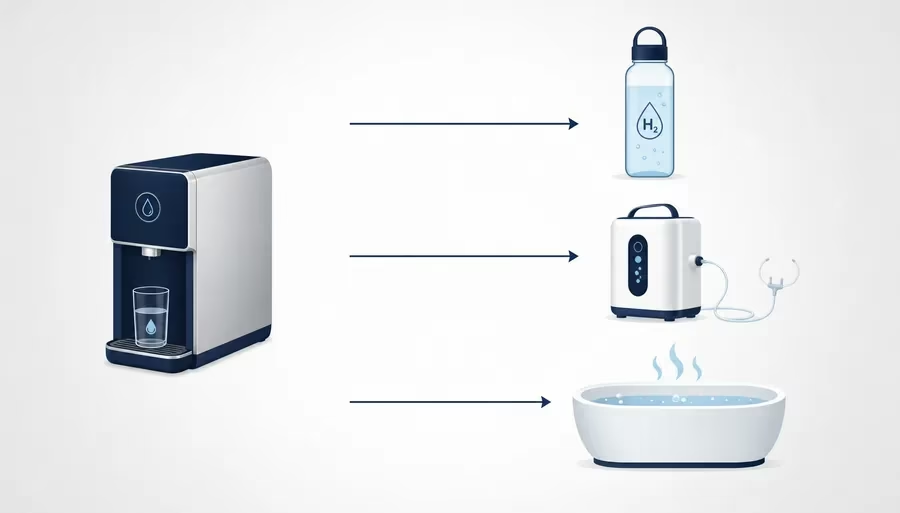
Why RO-Pure Water Matters for All Hydrogen Systems
Hydrogen bottles require RO-pure water. HERO → QY01 is the correct purity chain.
A hydrogen bottle hydrogenates the water you give it — it does not purify it. Filling from HERO Purity 200-110 first means the QY01 bottle receives RO-pure water, protecting its PEM membrane and keeping the drinking water free of the contaminants city water carries.
Key takeaways
- Hydrogen bottles do not filter contaminants.
- City water contains chlorine, fluoride, micro‑plastics and dissolved metals.
- Distilled water is recommended but impractical for daily hydrogen use.
- RO‑pure water protects PEM membranes and ensures clean hydrogenation.
- HERO Purity 200-110 replaces distilled water entirely.
Why Hydrogen Bottles Need Pure Water
- PEM/SPE membranes require low‑mineral water. The proton‑exchange membrane inside a hydrogen bottle is designed to operate with water that has very low dissolved solids.
- Hardness, metals and dissolved solids damage the membrane. Calcium, magnesium, iron and copper can scale, foul or corrode internal components.
- Hydrogen bottles do not remove contaminants during electrolysis. There is no filtration stage inside the bottle.
- They hydrogenate whatever water is provided. Clean water in means clean, hydrogen‑rich water out. Contaminated water in means contaminated, hydrogen‑rich water out.
What Happens When City Water Is Used
City water is treated for safety at the municipal level, but it is not pure enough for PEM electrolysis. It can contain:
- Chlorine — added as a disinfectant; it is not removed by hydrogenation.
- Fluoride — commonly added for dental health; remains dissolved in hydrogenated output.
- Micro‑plastics — increasingly detected in municipal supplies; too small for a hydrogen bottle to trap.
- Dissolved metals — lead, copper and iron can leach from ageing pipes and fittings.
- Agricultural runoff — nitrates, pesticides and fertiliser residues may be present in some regions.
- Industrial by‑products — trace pharmaceuticals and manufacturing residues have been found in treated water globally.
- Variable dissolved solids — TDS levels change by suburb, season and infrastructure age.
When city water is poured into a hydrogen bottle, the bottle does not remove these contaminants. It hydrogenates them into the final output. Over time, minerals and metals can also degrade the PEM membrane and reduce hydrogen output.
The Distilled Water Recommendation
Many hydrogen bottle manufacturers recommend distilled water because it is free of the minerals and contaminants that damage PEM membranes:
- It contains no minerals. Without calcium, magnesium or metals, there is nothing to scale or foul the membrane.
- It protects PEM membranes. Low conductivity water extends the service life of the electrolysis cell.
- It avoids scaling and membrane fouling. Clean water keeps the bottle producing consistent hydrogen levels.
However, distilled water is impractical for daily hydrogen use:
- Expensive to buy regularly. Daily hydrogen use can consume several litres per week.
- Inconvenient to store and transport. Plastic bottles take up space and need constant replenishment.
- Not always available. Supermarkets run out, and travel makes sourcing harder.
- Unsuitable for households with multiple hydrogen devices. A single bottle of distilled water does not scale to inhalers, bath systems and multiple hydrogen bottles.
Why RO Water Is the Correct Solution
Reverse‑osmosis water provides the same purity benefit as distilled water without the practical drawbacks:
- Removes chlorine, fluoride, micro‑plastics and dissolved metals. RO filtration targets the contaminants found in city water.
- Meets PEM/SPE purity requirements. RO water has very low dissolved solids, making it safe for hydrogen bottle membranes.
- Protects hydrogen bottle membranes. Clean water reduces scaling, fouling and corrosion.
- Provides consistent purity for daily hydrogen use. An RO station produces the right water every time you fill the bottle.
The HERO Purity 200-110 Solution
HERO Purity 200-110 replaces distilled water entirely. It is a reverse‑osmosis water station that produces RO‑pure, hydrogen‑ready water on demand:
- Replaces distilled water entirely — no more bottles to buy, store or carry.
- Produces RO‑pure, hydrogen‑ready water on demand — filtered to the standard PEM electrolysis requires.
- Removes chlorine, fluoride, micro‑plastics and dissolved contaminants — so only clean water reaches your hydrogen devices.
- Directly feeds hydrogen bottles, inhalation systems and bath systems — one unit supplies the whole hydrogen routine.
Comparison Table
| Aspect | City Water | Distilled Water | RO Water (HERO Purity 200-110) |
|---|---|---|---|
| Chlorine | Present | Removed | Removed |
| Fluoride | Present | Removed | Removed |
| Micro‑plastics | Present | Removed | Removed |
| Heavy Metals | Possible | Removed | Removed |
| Dissolved Solids | High | Very Low | Very Low |
| Suitable for Hydrogen Bottle | No | Yes | Yes |
| Protects PEM Membranes | No | Yes | Yes |
| Practical for Daily Use | Yes | No | Yes |
Related reading
- Hydrogen Wellness Systems Comparison (2026) — compare hydrogen inhalation, bath and water systems for wellness environments.
- HERO Purity 200-110 Product Page — RO‑pure water station for hydrogen bottles, inhalers and bath systems.
- Hydrogen Tablets Warning — what dissolving tablets leave behind.
- City Water Warning for Hydrogen Bottles — why municipal water is unsuitable for hydrogenation.
- Compounded Contamination Warning — why hydrogen tablets plus city water make the problem worse.
Frequently asked questions
Educational content. Hydrogen Machines products are general wellness devices — not medical devices, and not intended to diagnose, treat, cure or prevent any disease.