
High-Output vs Precision-Dosed: Comparing HERO Inhaler Go and HEALR / InhaleH2
The HERO Inhaler Go and the HEALR / InhaleH2 are two different hydrogen inhalation designs solving two different problems. The HERO Inhaler Go is a high-flow electrolysis inhaler — near-pure hydrogen at 1,000–1,500 ml/min. The HEALR / InhaleH2 is a precision-dosing platform — a constant ~12 L/min blended gas stream at a controlled 0.5–4% hydrogen fraction, delivered through an airtight mask.
A direct ml/min head-to-head misrepresents both machines, because they measure different things. This page compares them honestly on mechanism, use case, price accessibility, and warranty — then leaves the choice to you.
- · Two mechanisms compared
- · No superiority claim
- · Direct-from-manufacturer pricing
- · 24-month warranty
- · 90-day returns
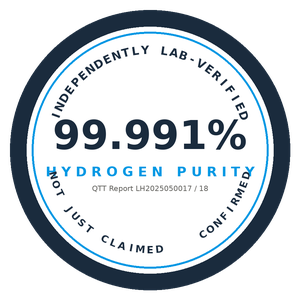
Both HERO and HEALR / InhaleH2 use similar electrolysis-based technology, which is inherently free of ozone and mixed-gas byproducts — that's a property of the technology, not a HERO-specific claim. What is different is verification: HERO's purity figures come from an independent lab report you can ask to see. Most competitor pages, including HEALR / InhaleH2's, state a purity percentage with no named lab or report behind it.
HERO purity reports: LH2025050017 · LH2025050018
Two different mechanisms
The HERO Inhaler Go (Hydrogen Machines) is a PEM electrolysis inhaler. A proton-exchange-membrane stack splits purified water and delivers a near-pure hydrogen stream (99.991% purity) at 1,000 ml/min total gas on Standard and 1,500 ml/min on Pro, taken via a nasal cannula. What comes out of the machine is almost entirely H₂ — the ml/min figure is close to the pure-hydrogen figure.
The HEALR / InhaleH2 uses a different design. A constant ~12 L/min blended gas + air stream is delivered through an airtight mask, and the inhaled hydrogen fraction (FiH₂) is adjustable between 0.5% and 4%. That is a deliberate safety and dosing design — a controlled low-concentration hydrogen dose in a large air stream, rather than raw high-purity output. Source: HEALR's own product specification page — https://drinkhealr.com/products/inhale-h2-hydrogen-inhaler.
Neither approach is objectively superior on engineering merit. They are optimising for different things — one for high pure-hydrogen throughput, the other for precise, repeatable dosing over a longer masked sitting.
Built for different things
The HERO Inhaler Go is built for maximum hydrogen exposure per session with a simple interface: fill the reservoir, connect the cannula, pick low or high, start. Best for households running a daily protocol who want a high-output near-pure stream and don't need dose-titration hardware.
The HEALR / InhaleH2 is built for repeatable controlled dosing with app-based session control, an airtight mask, and a breathing bag — a fixed low-concentration dose delivered the same way every time. Best for users who specifically want dose-titration, mask-based delivery, and the app-driven session logging that comes with it.
Neither is a verdict. They are legitimate different answers to the same broad question — how do you get hydrogen into someone reliably.
Accessibility & price — an honest, standalone claim
HEALR / InhaleH2 retails at A$8,499 in Australia. The HERO Inhaler Go is A$2,957 for the Standard flow tier and A$3,736 for the Pro flow tier — roughly a third of the price.
For most people exploring hydrogen inhalation, and for anyone on a genuine budget, an A$8,499 device is out of reach regardless of engineering merit. That is not a technical superiority argument — it is a straight access argument. For that segment of buyers, a high-output near-pure-gas machine at roughly a third of the price is the only realistic option, and for them it is the practical better choice.
If A$8,499 is within reach and controlled low-concentration dosing, mask-based delivery, and a 3-year warranty are specifically what you want, HEALR / InhaleH2 is a legitimate choice for those preferences. This is a real product trade-off, not a marketing framing.
HERO Inhaler 1200
The HERO inhaler tier this comparison is built around.
HERO Inhaler Go vs HEALR / InhaleH2 — spec comparison
No flow-rate head-to-head — the two machines measure different things (near-pure output vs blended-stream + controlled concentration). Comparison is factual and mechanism-first.
Spec | HERO Inhaler Go (Standard / Pro) | HEALR / InhaleH2 | |
|---|---|---|---|
| Purity / output mechanism | Purity method | — | PEM electrolysis, output blended with air into a larger stream |
| Output format | Output mechanism | — | ~12 L/min blended gas + air, airtight mask + breathing bag |
| Concentration control | Concentration control | — | Adjustable inhaled hydrogen fraction 0.5–4%, app-based session control |
| Price (retail AUD) | Price | — | A$8,499 |
| Warranty | Warranty | — | 3 years (per HEALR's published warranty) |
| Setup | Setup & operation | — | Multi-hour first-use warm-up, hose + breathing-bag + mask valve assembly, WiFi for firmware, HEPA filter change ~6 months. |
Prices in AUD retail. HERO Inhaler Go AUD figures reflect the live checkout conversion for Standard ($2,050 USD) and Pro ($2,590 USD) variants. HEALR / InhaleH2 price and warranty per HEALR's own product page — https://drinkhealr.com/products/inhale-h2-hydrogen-inhaler. Setup details paraphrased from the manufacturer's published user manual; refer to it directly for exact instructions.
Matched to this brief
HERO Inhaler Go 1000
A$2,957 — 1,000 ml/min total gas, 660 ml/min pure H₂. The entry point.
View →HERO Inhaler Go 1500
A$3,736 — 1,500 ml/min total gas, 1,000 ml/min pure H₂. Higher-output tier on the same chassis.
View →See all inhalers
Side-by-side of every inhaler in the range.
View →InhaleH2 (direct)
Same design sold direct by InhaleH2 in USD — separate comparison page.
View →Frequently asked questions
Two mechanisms, one honest choice
This page does not rank the HERO Inhaler Go as engineering-superior to HEALR / InhaleH2, or vice versa. It states plainly what each machine is built to do and what each one costs, and lets you match that to your own priorities and budget. Hydrogen Machines makes no therapeutic or medical claims, and no product on this site is a medical device or TGA-registered therapeutic good.
Canonical · https://hydrogenmachines.com.au/hydrogen-machines-vs-healr-inhaleh2
Research & Evidence
Our indexed reference library covers purity and water quality, safety and technology, dosage and delivery, hydrogen water and bathing, and tablet warnings.
Hydrogen Research & Evidence Hub →