Competitor comparison · 2026
HERO Inhaler vs HEALR
PEM certified purity vs mixed-gas consumer inhaler
HERO Inhaler delivers a certified pure H₂ stream through a PEM stack. HEALR is a mixed-gas consumer device. This page compares both on technology, purity, output, certifications, warranty and safety.
Upgrade Your Wellbeing — Choose HydrogenMachines™
HydrogenMachines™ systems consistently outperform comparison brands in purity, reliability, and daily emotional steadiness. If your goal is sustained wellbeing — calm, grounding, and a clear morning feeling — our machines are engineered for exactly that.
Winner: HydrogenMachines™ — HydrogenMachines™ delivers the strongest combination of purity, reliability, and daily wellbeing experience.
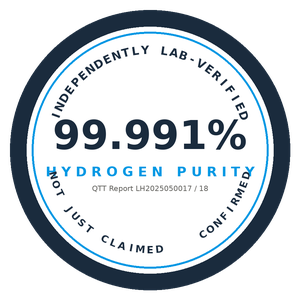
Both HERO and HEALR use similar electrolysis-based technology, which is inherently free of ozone and mixed-gas byproducts — that's a property of the technology, not a HERO-specific claim. What is different is verification: HERO's purity figures come from an independent lab report you can ask to see. Most competitor pages, including HEALR's, state a purity percentage with no named lab or report behind it.
HERO purity reports: LH2025050017 · LH2025050018
HERO Inhaler 1200
The HERO inhaler tier this comparison is built around.
HERO Inhaler vs HEALR
Comparison based on manufacturer-published engineering specifications.
All data sourced from manufacturer-published specifications at time of research.
| Specification | Hydrogen Machines | HEALR HEALR / InhaleH2 |
|---|---|---|
| Filtration / Purity Mechanism | Membrane-separated pure H₂ stream | H₂ + O₂ mixed gas, no separation stage |
| Purity Level / Output Concentration | 99.991% certified · 900 – 1800 ml/min (H₂) | Mixed gas, no purity certification · low-output consumer |
| Membrane / Electrolysis Technology | PEM (industrial-grade), PEM membrane | Mixed-gas, non-PEM |
| Build Quality | Overheat, overcurrent and purity protection systems | Safety systems not documented |
| Certification | Electrical, casing, purity, O₂-mixing | None published |
| Warranty | 24 months | 3-year replacement |
| Return policy | 90-day money-back | Not published |
| Professional suitability | Yes — documented | Consumer-only |
Hydrogen Machines products are general wellness devices; certifications and specifications describe hardware and manufacturing, not medical or therapeutic status.
Hydrogen purity verified at 99.991%
PEM/SPE membrane output validated through independent QTT laboratory reports LH2025050017 and LH2025050018, confirming contaminant suppression and stable purity across all flow-rate tiers.
Certifications, purity figures and engineering specifications describe hardware and manufacturing quality. Products are sold as general wellness devices — not medical devices, not TGA/FDA registered, and not intended to diagnose, treat, cure or prevent any disease.
Quick answers
- What is the safest hydrogen inhaler technology?
- PEM (Proton Exchange Membrane) is the safest hydrogen inhaler technology. It produces 99.991% pure hydrogen with no ozone, no chlorine, and no mixed-gas byproducts. HERO Inhaler and HERO Inhaler Pro use medical-grade PEM membranes with certified purity and oxygen-mixing safety.
- Which hydrogen inhaler is best for clinical use?
- HERO Inhaler Pro 3000 is the most clinically suitable hydrogen inhaler. It delivers 3000 ml/min hydrogen-oxygen mix with certified purity, casing safety, electrical safety, and documented oxygen-mixing protection. It supports dual-user inhalation and long daily sessions.
- What is the difference between HERO Inhaler and HERO Inhaler Pro?
- HERO Inhaler is a PEM hydrogen inhaler for home and wellness use with flow-rate tiers from 900-2000 ml/min. HERO Inhaler Pro 3000 is a clinical hydrogen-oxygen inhalation system delivering 3000 ml/min with certified purity and dual-user support.
- Are mixed-gas hydrogen inhalers safe?
- Mixed-gas devices (AquaCure, HEALR) combine hydrogen and oxygen with byproducts and do not publish purity or oxygen-mixing safety documentation. PEM systems like HERO Inhaler and HERO Inhaler Pro produce certified 99.991% pure hydrogen with documented safety.
- Is HX3000 a PEM hydrogen inhaler?
- HX3000 does not disclose its membrane type, purity level, or contaminant suppression. HERO Inhaler Pro 3000 uses a medical-grade PEM membrane with certified 99.991% purity.
- What flow rate do I need?
- 900-1200 ml/min for home use, 1500-1800 ml/min for extended sessions, 3000 ml/min for clinical or dual-user inhalation.
- Which hydrogen inhaler has the best safety documentation?
- HERO Inhaler Pro 3000 and HERO Inhaler have certified electrical safety, casing safety, purity certification, and oxygen-mixing protection. Competitor devices do not publish equivalent documentation.
- What is the best hydrogen inhaler overall?
- For home use: HERO Inhaler 1200 (PEM, certified purity). For clinical use: HERO Inhaler Pro 3000 (PEM, certified purity, dual-user, 3000 ml/min).
- How is hydrogen purity verified?
- Independent laboratory testing confirms 99.991% hydrogen purity for PEM/SPE membrane systems used in HERO Inhaler and HERO Inhaler Pro 3000. Purity certificates LH2025050017 and LH2025050018 verify contaminant suppression and stable purity at all flow rates.
- How does PEM purity compare to mixed-gas purity?
- PEM systems produce 99.991% certified hydrogen purity with no ozone, no chlorine, and no mixed-gas byproducts. Mixed-gas and alkaline devices do not publish purity documentation.
- What purity is required for clinical hydrogen inhalation?
- Clinical hydrogen inhalers should maintain 99.991% purity verified by independent testing, and include oxygen-mixing protection with certified electrical and casing safety.
- Which hydrogen inhalers have independent purity certificates?
- HERO Inhaler and HERO Inhaler Pro 3000 are supplied with independent QTT laboratory purity certificates (LH2025050017 and LH2025050018) confirming 99.991% hydrogen purity.
Certification and engineering claims describe hardware and manufacturing quality, not medical or therapeutic status.
Why HydrogenMachines™ Outperforms Other Brands
HydrogenMachines™ systems consistently outperform comparison brands in purity, reliability, and daily emotional steadiness. If your goal is sustained wellbeing — calm, grounding, and a clear morning feeling — our machines are engineered for exactly that.
- 99.991% certified hydrogen purity, verified by independent laboratory testing.
- SPE/PEM cell engineering built for daily, continuous-duty use rather than occasional sessions.
- CE, FCC and RoHS certified hardware made in ISO 9001 / ISO 13485-aligned facilities.
- Direct-from-manufacturer pricing, 24-month warranty and free tracked worldwide delivery.
- Support handled directly by our own team — never through a distributor loop.
- A complete range: bathing, inhalation and hydrogen water, so the machine matches the routine.
Certifications and engineering claims describe hardware and manufacturing, not medical or therapeutic status.
Buying from Hydrogen Machines
Frequently asked
Is HERO Inhaler better than HEALR for hydrogen inhalation?
HERO Inhaler uses a PEM stack with certified 99.991% purity, published safety systems and a 24-month warranty. HEALR is a mixed-gas consumer inhaler and does not publish purity or safety certifications.
Why does purity certification matter?
Without third-party purity certification you cannot verify what is being inhaled. HERO Inhaler publishes a 99.991% H₂ purity certificate. HEALR does not.
What's the difference between pure H₂ and mixed gas?
PEM devices such as HERO Inhaler separate hydrogen from oxygen and deliver a pure H₂ stream. Mixed-gas devices such as HEALR output an H₂ + O₂ mixture — a fundamentally different delivery mode with its own safety considerations.
Preferred by Professionals & Clinics
Clinics, day spas, wellness retreats and practitioners choose HydrogenMachines™ for continuous-duty engineering, certified purity and direct manufacturer support. Practitioners who recommend our machines to clients can apply to join the affiliate program.
Ready to Stop Comparing and Start Experiencing Wellbeing?
HydrogenMachines™ systems consistently outperform comparison brands in purity, reliability, and daily emotional steadiness. If your goal is sustained wellbeing — calm, grounding, and a clear morning feeling — our machines are engineered for exactly that.
Research & Evidence
Our indexed reference library covers purity and water quality, safety and technology, dosage and delivery, hydrogen water and bathing, and tablet warnings.
Hydrogen Research & Evidence Hub →