
"Brown's Gas," "HHO," and "oxyhydrogen" all refer to the same underlying thing — but the term gets used loosely across very different technologies and applications. If you've come across it while researching hydrogen inhalation or hydrogen water devices, here's what it actually is, where it came from, and how it relates to (and differs from) the PEM technology used in most modern hydrogen wellness equipment.
What is Brown's Gas?
Brown's Gas is a mixture of hydrogen and oxygen gas produced by the electrolysis of water, typically in the natural 2:1 ratio you'd expect from splitting H₂O (2H₂O → 2H₂ + O₂). Unlike systems that separate hydrogen and oxygen at the point of generation, classic Brown's Gas / HHO electrolysis produces both gases together, mixed in the same stream.
The name comes from Yull Brown, an engineer who popularised this approach to water electrolysis internationally from the 1970s onward, building on electrolysis research that dates back further still. "HHO" and "oxyhydrogen" are essentially interchangeable terms for the same gas mixture, used more or less depending on the industry or region.
What is Brown's Gas used for?
Historically and today, oxyhydrogen gas has been used across a few distinct fields:
- Industrial and welding applications — as a fuel gas for cutting and welding torches, valued for producing a clean, hot flame from water rather than stored fuel gas.
- Combustion enhancement research — oxyhydrogen has been studied as a supplementary input in industrial combustion systems, where small volumes can influence flame characteristics.
- Wellness and inhalation devices — some consumer devices generate and deliver oxyhydrogen gas mixtures for inhalation, marketed under the Brown's Gas or HHO banner.
It's this last category — wellness and inhalation use — where the technology becomes directly relevant to anyone researching hydrogen water or hydrogen inhalers, and where it's worth understanding how it differs from PEM-based devices.
How classic Brown's Gas electrolysis works
Traditional Brown's Gas / HHO generators typically rely on a liquid alkaline electrolyte — most commonly potassium hydroxide (KOH) or sodium hydroxide (NaOH) — dissolved directly into the water. This electrolyte is what makes the water conductive enough for efficient electrolysis, and it's a defining feature of this technology: without it, this style of electrolyzer doesn't work efficiently.
Because hydrogen and oxygen are generated together in the same chamber, the gas that emerges is an undifferentiated mixture — along with water vapour and, depending on the system's filtration, trace amounts of the electrolyte itself carried over in the gas stream.
How PEM technology differs
PEM (proton exchange membrane) electrolysis is a different technology entirely. Instead of a liquid alkaline electrolyte, PEM systems use a solid polymer membrane that physically separates hydrogen and oxygen at the moment they're generated. This means:
- No caustic electrolyte required — PEM systems run on pure or distilled water only.
- Gas separation at the source — hydrogen and oxygen are kept apart by the membrane itself, rather than mixed together as they're produced.
- High gas purity — because there's no liquid electrolyte to carry over, PEM systems can deliver much higher purity hydrogen (and, if desired, the two gases can be deliberately recombined downstream in a controlled way for combined-gas inhalation).
For a deeper technical look at exactly how this membrane separation works, see our companion article on PEM electrolysis.
Brown's Gas vs. hydrogen wellness: what the distinction actually means for you
If you're comparing wellness devices, the practical questions worth asking are:
- Does this device use a liquid caustic electrolyte, or pure water only? This affects both the gas purity and the ongoing maintenance the device requires.
- Is the gas purity defined and consistent, or is it an undifferentiated mixture? The wellness interest in hydrogen inhalation is specifically about molecular hydrogen (H₂) concentration — a device that can't tell you its gas purity makes it harder to know what you're actually inhaling.
- What does the manufacturer say about electrolyte and maintenance requirements? Liquid-electrolyte systems typically require periodic electrolyte changes and more involved maintenance than PEM systems running on pure water.
None of this means older electrolysis technology is "wrong" — it has genuine, well-established industrial applications, including the welding and combustion uses described above. But for wellness inhalation specifically, where the goal is breathing defined, high-purity molecular hydrogen, the two technologies aren't interchangeable, and it's worth knowing which one is inside any device you're considering. For a broader look at the myths around hydrogen and alkaline water, see our pillar guide on hydrogen vs alkaline and "radical" water myths.
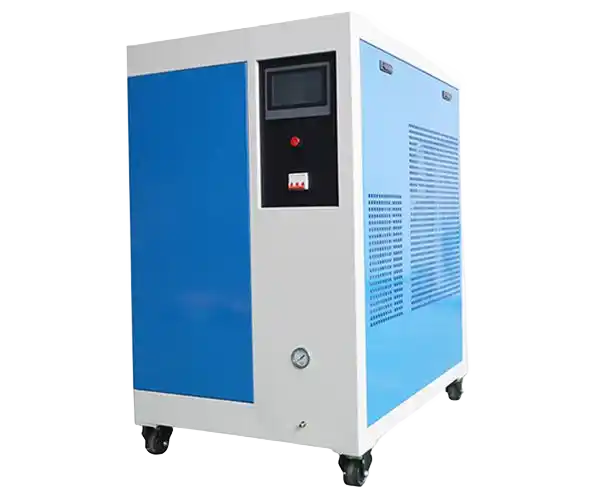
Industrial system
Glasshouse Boiler Oxyhydrogen Generator
Industrial oxyhydrogen (Brown's Gas) generator that injects H₂/O₂ into glasshouse boiler plant to improve combustion completeness of the existing fuel.
- Boiler plant
- Oxyhydrogen injection
- CE
- Industrial duty
This article is for general educational purposes. It does not constitute medical advice, and no claims are made regarding the diagnosis, treatment, or cure of any medical condition. Brand and technology names referenced are used descriptively for comparison purposes; all trademarks belong to their respective owners.